
Teuton Royalties in the Sulphurets Hydrothermal System
The Sulphurets Hydrothermal System (“SHS”) is “elephant country”—meaning it is a region in which very large and/or very high-grade deposits have already been found. It is the most heavily mineralized part of British Columbia’s famous Golden Triangle and home to both Newmont Mining’s Brucejack-Snowfield gold property and Seabridge Gold’s KSM gold-copper property. This large mineralized system spans a distance of some 30 km north-south and is marked by an abundance of prominent “gossans”—bright yellow, red and orange zones of alteration created by intense hydrothermal activity.
Teuton owns royalties in ten different areas within this prolific region. Teuton’s 10 royalty areas lie both in the northern third of the system (Treaty Creek property) and in the southern third (King Tut, Tuck, High North, Orion, Delta and Fairweather properties). The center of the system covers BC’s Valley of the Kings gold mine which has been in continuous production since 2017. To the west it hosts what has been termed “one of the world’s largest reserves of copper and gold” in the various KSM deposits owned by Seabridge Gold. The Valley of the Kings gold mine was acquired by Newcrest Mining when it bought owner Pretium Resources for $2.8 billion in 2021. Later Newcrest Mining was in turn taken over by Newmont Mining for $19.1 billion US in 2023.
NOTE: In 2023, a new resource estimate was completed for the Goldstorm deposit at Treaty Creek. It now contains an Indicated Mineral Resource of 23.37 million ounces (Moz) of gold equivalent (AuEq) within 641.93 million tonnes (Mt) at a grade of 1.13 g/t AuEq; comprised of 18.75 Moz of gold (Au) at 0.91 g/t, 112.44 Moz of silver (Ag) at 5.45 g/t, and 2.18 billion pounds (Blbs) of copper (Cu) at 0.15 %. It also contains an Inferred Mineral Resource of 7.35 Moz AuEq within 233.90 Mt at a grade of 0.98 g/t AuEq; comprised of 5.54 Moz Au at 0.74 g/t, 45.08 Moz Ag at 5.99 g/t, and 848.00 million pounds (Mlbs) of Cu at 0.16 %. [Full details can be found in the Treaty Creek property section.]
This resource estimate is scheduled for another update before the end of 2025. Tudor Gold, the Operator of the Treaty Creek Project, has announced plans to put out a smaller, higher grade resource predicated on 5m X 5M X 5m blocks within the overall lower grade material. The hope is that this resource can form the basis of a stand-alone pre-feasibility study.
Click here to download map as a PDF.

Important Markers in the Sulphurets Hydrothermal System
Studies by the British Columbia Geological Survey have shown that all of the five Seabridge Gold KSM deposits discovered to date lie close to an important geological contact known as “Kyba’s Red Line”. They are also all spatially related to a prominent thrust fault, the “Sulphurets”. Both the Red Line and the Sulphurets thrust fault pass northeastward from the KSM property into the Treaty Creek property continuing onward for kilometres. Exploration at Treaty Creek has now surpassed $100 million dollars, which although a very big sum is only a small fraction of what has been spent to date at the neighbouring KSM and Brucejack properties.
Drill intersections containing gold mineralization up to a 1,000+ meters in length have been obtained at the Goldstorm. The Goldstorm along with three other zones–Perfect Storm, Calm Before the Storm and Eureka–all still retain significant potential for expansion.
The same Red Line and Sulphurets Fault also pass southward into and along Teuton’s royalty areas located in the southern third of the System. Although drilling in this area has been minimal to date, a single hole drilled into the King Tut zone in 2012 intersected 222 metres of 0.88 g/t gold demonstrating that gold mineralization continues to the south. Work in the past two years by Tudor Gold spin-out company, Goldstorm Metals Ltd., has shown a long promising copper-gold-silver occurrence called the “Copernicus” on their Orion property on which Teuton retains a 2.5% Net Smelter Royalty. A geophysical survey conducted in August and September of 2025 revealed an extensive anomaly on this property which will be further investigated in 2026.
The ten royalty areas can be seen on the attached map. For details on any particular area, press the Royalty Areas button located on the right hand side.
“Royalties”—Valuable or Not??
Teuton’s royalties in the SHS vary from 0.49% to 2.5%, averaging 2.0% Could such numbers bring value to the Company?
Yes. These percentages hold potential to bring significant future value to Teuton Shareholders and are one of the cornerstones of the Prospector Generator strategy.
Case Study #1: What would a 1% NSR be worth on Seabridge Gold’s proven and probable gold reserves on its KSM property at today’s gold prices (January 19, 2026)?
Answer: About $2.48 Billion
Case Study #2: What would a 2% NSR be worth on the 2024 gold resource remaining at Newmont Mining’s Valley of the Kings deposit using today’s gold prices (January 19, 2026)?
Answer: About $199 million.
Assumptions: We anticipate that 90% of the gold in a resource will be recoverable. Of that remaining 90% we then deduct an estimated 10% for cost of transportation of concentrate to smelter and smelting costs. These are generally the only significant deductions allowed when calculating an NSR. Other items such as cost of mining, cost of milling, operating expenses, administrative expenses, capital cost, payment of interest, etc. —all these are not deductible from a typical NSR.
Case Study #1 calculation: Seabridge Gold’s KSM deposits currently have proven and probable reserves of 47.3 million ounces of gold, 7.3 billion pounds of copper and 160 million ounces of silver. For now, we will only consider the value of the royalty on gold using today’s price of $5,756 CDN per ounce. Assuming 90% of this gold is recoverable, we are left with 42.57 million ounces million ounces. Subtract 10% of this for typical NSR deductions: that leaves 38.3 million ounces, of which 1% or 383,000 ounces is payable to the royalty owner. Value at the current gold price of $6,480 CDN is roughly $2.48 billion CDN. If you add copper to the mix, even with a reduced say 80% recovery, it would be significantly higher.
Case Study #2 calculation: Newmont Mining’s Valley of the Kings gold mine had proven and probable reserves of 8.6 million tonnes at 6.95 g/t gold as at Dec. 31, 2024 which equates to 1.9 million ounces of gold. Assuming 90% of this gold is recoverable, the 2% NSR holder would have earned 34,200 ounces. Subtract 10% of this for typical NSR deductions leaves 30,780 ounces worth $199 million at current prices.
Cautionary Note: These numbers are cited here solely for educational purposes, to give the reader an idea of the potential value of a royalty in a SHS deposit As one can see, these numbers are very large. However, at this stage of exploration at Treaty Creek or other Teuton royalty properties, they represent only a potential, as no positive feasibility study has yet been established. Although the last resource calculations at the Goldstorm zone mark an important step forward, one cannot guarantee that the property will progress to production. The similarity and proximity of deposits on either Newmont Minings Brucejack property or Seabridge Gold’s KSM property is not necessarily indicative of the gold mineralization on any of Teuton’s royalty properties.
The Beauty of NSRs—No Risk
The most successful companies in the “gold space” are the royalty companies. Once they acquire a royalty, that is the end of their financial commitment. A producer may mine gold for many years and never recoup its capital costs, yet it would still be required to pay a royalty to the NSR holder. Remember–the most important aspect of an NSR is: the company which owns it risks nothing!


Area 1—Treaty Creek Property: Core Claims
This core section of the Treaty Creek property is presently being explored by Tudor Gold, a company originally headed up by Walter Storm, the German financier who made a fortune as one of the early investors in Osisko Gold. Tudor has spent over $100 million on the property to date with an additional $9 million having been spent by earlier optionees. According to the terms of the Treaty Creek Joint Venture agreement, Tudor is the operator and is responsible for funding all costs on the property until such time as a production decision is made. Current partners in the joint venture are Teuton-20% (carried until a production decision is made) and Tudor Gold – 80%.
Ken Konkin, one of the co-winners of British Columbia’s Spud Huestis award, signed on in early 2019 as Tudor Gold’s Exploration Manager. Mr. Konkin previously worked for many years heading exploration of Pretium Resources’ Valley of the Kings gold mine. The Valley of the Kings is the first of many deposits in the Sulphurets Hydrothermal System to see production. Other gold deposits in the area include Seabridge Gold’s Kerr, Deep Kerr, Sulphurets, Mitchell and Iron Cap deposits as well as the giant Snowfield gold deposit (now called Mitchell East) that was sold to Seabridge Gold by Pretium Resources in 2020.
What used to be Pretium’s Snowfield deposit is located a few kilometers south of the border with the Treaty Creek property and currently has a measured and indicated .resource of 25.9 million ounces of gold (1,370 million tonnes at 0.59 g/t gold). After visiting the Treaty Creek property in 2018 and examining some of the drill core, Mr. Konkin stated: “I was impressed as to the similarity of some of the mineralization seen at Copper Belle and that of the Snowfields Gold zone. Although the rocks were very similar between the two, the alteration was much stronger within the specific mineralized zones at Copper Belle as well the level of pyritization was also stronger. This broad-type of alteration and mineralization is commonly associated with intrusive-related hydrothermal fluid systems from regional events. In other words, these systems tend to part of large regional events such as those found at the neighboring Seabridge and Pretium properties rather than smaller localized events.”
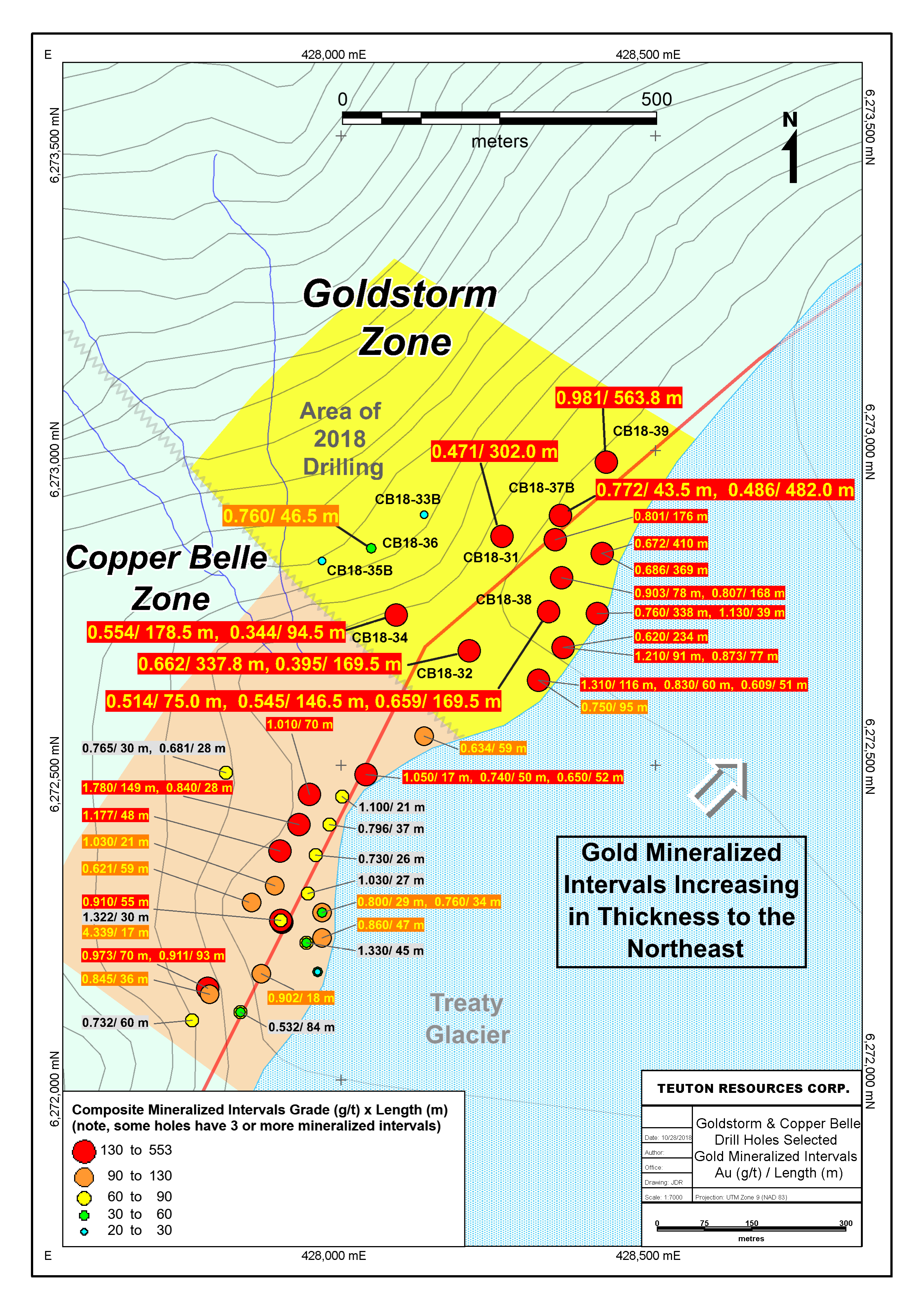
At the time of the quote, the entire gold zone drilled by Tudor Gold from 2015 to 2018 was referred to as the Copper Belle. Subsequent studies have shown that the northern portion is a separate system, one now known as the Goldstorm zone. This northern zone appears to more continuous and well-mineralized, and is the part referred to in the comparison to the Snowfield deposit. Mr. Konkin’s early comparison has been borne out by drilling at the Goldstorm in the past seven years. Many outstanding intersections were obtained during that time, some reaching lengths of over 1,000 metres.
A maiden resource was calculated for the Goldstorm/Copper Belle in March of 2021 which was updated in 2023. See here for details. Exploration aimed at expanding the resources will continue in 2026.
Currently, Area 1 represents Teuton’s best chances of establishing a royalty in a known deposit within the Sulphurets Hydrothermal System. Royalty rate for this area is just under 1% at 0.98%. There is no buyback on this royalty. Teuton also has a 20% ownership and carried interest in the Treaty Creek property as a whole, carried until such time as a production decision is made.
Alongside the Goldstorm zone there are several other targets within the core property that have significant potential to host large gold deposits. These center on large geophysical anomalies and/or gossanous zones which have not seen extensive exploration to date.


Area 2—Treaty Creek Property: Peripheral Claims
This area constitutes all of the surrounding claims to the core of the Treaty Creek property in Area 1. It also includes some of the Treaty Creek claims lying between Seabridge’s Iron Cap deposit (which lies 800m from the KSM-Treaty Creek property border) and the southwestern end of the nunatak hosting the Copper Belle and Goldstorm deposits. Some large scale magnetotelluric anomalies lie within this ground as well as some magnetic anomalies. The progression of deposits starting from Kerr to Sulphurets to Mitchell to Iron Cap to Copper Belle and Goldstorm suggests there may be room for another deposit within this space. There is also room for discovery northeast of the core group beyond the limits of Area 1. Several gossanous areas are evident in this section.
The peripheral claims occupy the southwest extension of the Perfect Storm zone toward the boundary with Seabridge Gold as well as the northeastward extension of the Calm Before the Storm (“CBS”) zone.
Primary royalty rate for this area is just under 0.49%. However, Teuton also owns a buyback right on half of a 2.0% NSR owned by St. Andrew Goldfields in this peripheral area. Teuton can acquire an additional 1.0% royalty for $1 million at any time up to six months from the commencement of commercial production. If it were to do so it would own a 1.49% royalty in these peripheral claims. Teuton has not given a buyback on either of these two royalty segments.

Area 3–King Tut and Tuck Properties
This area encompasses the region south of the Valley of the Kings gold mine that was subsequently sold by Teuton to Pretium in 2015. When Teuton owned the claims they were known as the “King Tut” and “Tuck” properties. A single hole drilled by Teuton in 2012 on the King Tut (see pictures) intersected 222m grading 0.88 g/t gold demonstrating the gold values persist in this part of the SHS. No follow-up drilling took place to test the depth at which the mineralization was encountered, however prospecting in an area south of the drill collar showed good gold grades between 4.8 and 63.0 g/t gold and between 18 and 86 g/t silver.
On the Tuck claims ablation of snow and ice revealed an extensive alteration zone in 2014. This zone is marked by strong sericite alteration, strong quartz stockwork, strong jarosite staining, anomalous arsenic with gold values, and abundant pyrite associated with the gold values (see photo). In 2019 Pretium drilled five holes into the zone in 2019 and reported results as follows: “The Tuck Zone is located 7 kilometers south of the Brucejack Mine. A bed of intensely quartz-sericite-pyrite altered andesitic volcanics of the Unuk River Formation hosts low grade gold in pyrite. The showing is part of a linear trend that includes Snowfield, Brucejack, and Bridge Zone along the eastern margin of the Brucejack Fault. Five drill holes completed in 2019 tested a 400-meter-long section of the zone, all of which intersected a flat lying bed of intensely altered volcanics that contained low grade gold associated with pyrite.”
Teuton has a royalty of 2.0% in this region. There is no buyback on this royalty.


Area 4—IC2 Claim
This small property was originally acquired by Teuton by a third party and subsequently sold to Pretium. Not much is known about its potential, but it is well situated between the Sulphurets and Brucejack Faults.
To begin with a 1.5% NSR is payable to the original owner, and a 0.5% NSR is payable to Teuton. After $500,000 is paid to the original owner, the NSR payable to Teuton increases to 2.0%. There is no buyback on this royalty.
Area 5—High North Property
This is a high altitude, rugged property which nevertheless has significant potential for hosting deposits as found immediately to the north on Seabridge Gold’s KSM property. Jeff Kyba’s “Red Line”—the contact between rocks of the Triassic age Stuhini Group and Jurassic age Hazelton—passes southward from the KSM property throughout the High North. The important Sulphurets Fault also passes through 5km of the High North property.
As reported in the Norther Miner, “Geologists Jeff Kyba and Joanne Nelson from the British Columbia Geological Survey may have unlocked the secret to world-class porphyry and intrusion related gold-copper deposits in northwestern B.C.
They’ve discovered that most of the major deposits in the region occur within 2 km of a regional stratigraphic contact, and, according to Kyba, there are lithological and structural clues to narrow that window even further.
“If you’re near that red line, and there’s a clastic sequence coupled with large-scale faults then you might be in the neighborhood of B.C.’s next big deposit,” he says. “And knowing that is a big game-changer for explorers in the region because it’ll get them closer to making a discovery.” [Excerpted from the May 1,2015 Edition of the Northern Miner]
Speaking specifically about the KSM and neighbouring Brucejack properties, Kyba also stressed the importance of the Sulphurets fault, which he believes to be an important second key to locating mineralization. More of the Northern Miner article, follows:
But a change in lithology across the contact isn’t the only thing Kyba suggests is a useful proxy to finding “nation-building” ore deposits.
Brucejack and KSM are both encased in a large halo of a highly deformed, quartz-sericite-altered host rock. Immediately to the east is a large, Cretaceous-aged thrust fault called “Sulphurets” that caps the altered ore-host.
Kyba reckons that it’s no coincidence the prominent fault is so close to the deposits.
“When the Stikine was compressed, all the prospective structures bounding these old basins were slippery because of the alteration associated with the porphyries. So they were the first to fail, and became reactivated as younger, prominent thrust faults.” [Excerpted from the May 1,2015 Edition of the Northern Miner]
The property has been purchased by Tudor Gold and Teuton owns a 2.5% NSR in the High North property. Subsequently, Tudor Gold spun the property out to Goldstorm Metals Ltd., the current owner. There is no buyback on this royalty.


This very large property lies to the south of Teuton’s High North property and covers the southern end of the McTagg anticlinorium, a regional structure which hosts all of the various copper-gold deposits of the KSM property to the north. The western half of the property occupies a substantial portion of the Eskay rift.
The prominent feature of the eastern part of the property is a nunatak (rock island surrounded by ice) which rises out of the upper reaches of the Frank Mackie glacier, broadening to the north. Much of the nunatak is gossanous. It is composed of extensive felsic volcanics overlain by fine, carbon-rich sediments, both mapped as of Jurassic age.
Prospecting carried out in 2018 disclosed an area marked by abundant sulfur, much like that previously discovered at Sulphur Knob on the Treaty Creek property. Just to the west of this occurrence is a large magnetotelluric (“MT”) anomaly detected at depth during a survey conducted in 2016. Another MT anomaly occurs on the eastern side of the nunatak. Neither anomaly has been drill-tested.
The property was purchased by Tudor Gold with a 2.5% NSR retained by Teuton. Subsequently, Tudor Gold spun the property out to Goldstorm Metals Ltd., the current owner. There is no buyback on this royalty.


Area 7—Delta East Property
In 1985 prospecting on the Delta East property disclosed an area of highly anomalous heavy metal stream sediments, ranging from 1,255 to 6,500 pbb gold and from 20.0 to 141 ppm silver, occurring within an altered zone partially composed of sericite schists. The property was subsequently optioned to Canarc Resources which carried out property wide geochemical surveys as well as minor geophysics. A Canarc geologist stated: “Geophysical IP anomalies in the vicinity of the J Zone indicate the possible presence of metal sulfides near a rhyolite-argillite contact. Some potential exists for Eskay Creek-type gold rich massive sulfide deposits on the Delta Property”.
After the property was returned to Teuton, some minor prospecting and drilling was carried out on targets in the Feld Gossan area. Although some substantial gold values were obtained in surface sampling, from 0.74 to 47.8 g/t gold, the limited drilling that took place encountered only narrow gold intersections. Another small drill program intersected narrow intervals of what appeared to be massive sulfide type mineralization.
Over $1 million has been spent on the property to date
The Delta East property was purchased by Tudor Gold but has now been spun out to Goldstorm Metals Ltd., the current owner. Teuton owns a 1.5% NSR with no buyback.

Area 8—Delta West Property
This is a relatively unexplored section of the geology lying east of Kyba’s redline. The property was purchased by Tudor Gold but it has since been spun out to Goldstorm Metals Ltd. Teuton retains a 2.5% NSR (no buyback).
Area 9—Fairweather East Property
The Fairweather East property adjoins the Delta East property to the south and is underlain by a continuation of the Jurassic age rock formation underlying Pretium’s Brucejack property.
In 1987 geologist Ken Konkin discovered a pyritic, quartz brecciated conglomerate zone on the Fairweather which was trenched and yielded an average grade of 4.04 g/t gold over 7.0 metres. A similar zone was sampled uphill from this occurrence, returning anomalous gold values of 720, 780 and 1045 ppb (grabs). Exposure in the area was quite poor with deep overburden in places. The next year the site was revisited but limited follow-up work failed to reach bedrock. Although the zone was recommended to be tested by a series of shallow holes, such work is yet to be done. A cluster of soil geochem gold anomalies lies downhill from the occurrence.
In 2018, Ken Konkin revisited the property and discovered an exhalative horizon which he believes has potential for hosting VMS-style mineralization.
The Delta East property was purchased by Tudor Gold but has been spun out to Goldstorm Metals Ltd.. Because of pre-existing royalties, Teuton’s royalty in this property is lower at 1%. There is no buyback on this royalty.
Area 10—Fairweather West Property
This is a relatively unexplored section of the geology lying east of Kyba’s redline. It has been purchased by Tudor Gold which spun out it to Goldstorm Metals Ltd. Teuton retains a 2% NSR with no buyback.
